

What Is Domain Rating (DR)? How to Use It When Choosing Publications
Browse any list of websites for guest posts or press releases and you will meet a column called DR. It is one of the most quoted numbers in online publishing, and one of the most misunderstood. This guide explains what domain rating is, what it can tell you, and where it stops being useful.
We also show how DR appears on Coneberry, a dashboard where brands publish articles and press releases on 5,000+ real news and business websites, so you can use it to compare publications with confidence.
What is Domain Rating?
Domain Rating is a score from 0 to 100 that estimates how strong a website’s backlink profile is. A backlink is a link from another website to this one. The more links a site has from other strong sites, the higher its DR tends to be.
Also worth a look: Do-Follow vs No-Follow Links: What They Mean for Your Brand and How Publications Build Your Brand’s Reputation and Authority.
DR was created by a third-party SEO tool. It is not a Google score, and Google does not use it. Other tools publish similar scores under different names. Think of DR as a convenient yardstick, not an official grade.
How is DR worked out?
The tool looks at how many different websites link to a site and how strong those linking sites are. A link from a strong site counts for more than a link from a weak one. The result is placed on a scale from 0 to 100, and it is relative: moving from 70 to 71 is much harder than moving from 10 to 11.
Scores are recalculated regularly, so a site’s DR can move up or down over time.
Why does DR matter when you publish?
It is a quick comparison
When you look at thousands of publications, you need a way to narrow the list. DR gives you a simple number to sort and filter by.
It hints at how established a site is
A high DR usually means a site is widely linked to and well known. That can add to the credibility of being published there. Our guide How publications build your brand reputation and authority explains why this matters.
It may support your rankings, as a bonus
If your article includes a do-follow link, a link from a stronger site may help your own site’s search rankings. Treat that as a bonus. No one can guarantee rankings. See Do-follow and no-follow links explained.
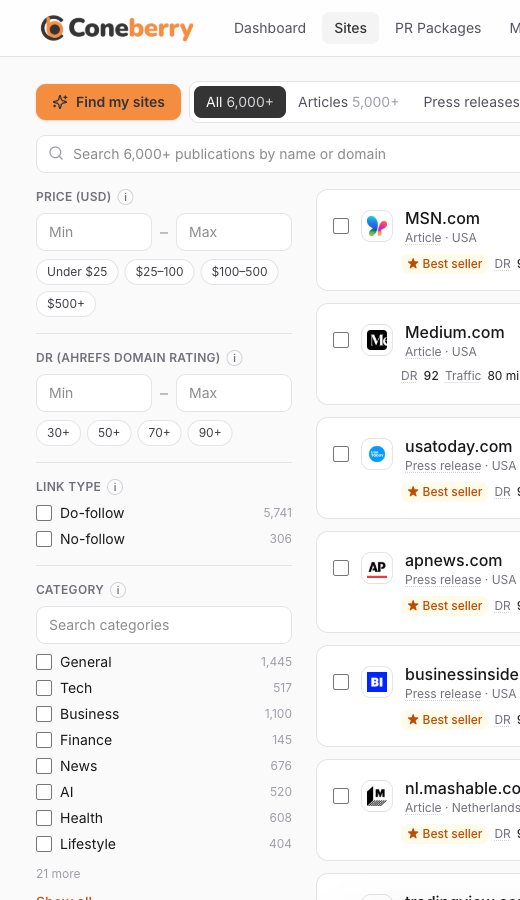
The DR range filter shows only publications between the scores you choose.
What DR does not tell you
This is where many buyers go wrong. DR measures links. It does not measure:
- Audience. A site can have a high DR and few real readers.
- Relevance. A high-DR site about cooking will not help a software company.
- Editorial quality. The score says nothing about how good the articles are.
- Safety for your topic. Some sites do not accept finance, crypto or health content at all.
That is why DR should be one input, never the only one.
What is a good DR for you?
It depends on your goal and budget.
- Lower DR sites are often niche and more affordable. They suit local businesses and specialist topics.
- Mid-range DR sites are established publications with real audiences. They suit many growing brands.
- High DR sites are large, well-known publications. They cost more and suit brands that want broad credibility.
Rather than chasing the highest number, look for the best fit between a site’s audience and yours.
How to use DR on Coneberry
- Open Sites. Every card shows DR, traffic, country, link type and price.
- Set the DR range filter on the left to cover the scores you want.
- Sort by DR when you want to see the strongest sites first.
- Combine it with the category, country, traffic and link type filters.
- Open the Sample link on a card to read a real article from that site.

Each card shows DR next to traffic, country, link type and price.
If you would rather not choose from a long list, the Find my sites quiz asks six short questions, including the DR you prefer, and suggests matching publications.
Words with a dotted underline, such as DR, show a short explanation when you hover or tap.
What should you remember about accuracy?
DR comes from third-party tools and publishers, not from Coneberry. It can change at any time and is not guaranteed. The same applies to traffic, link type, country and turnaround. Publications may label content as sponsored or partner content. Google indexing and ranking improvements are never guaranteed.
A short example
Say you compare two sites for an article about your accounting software. Site A has a DR of 80 and covers general entertainment. Site B has a DR of 45 and covers small business finance. Site A looks stronger on paper, but its readers are not looking for accounting software. Site B is smaller, but nearly every reader is a possible customer. For most brands, Site B is the better choice.
That is the point of using DR as a first filter and then judging fit.
Keeping DR in perspective
Many brands over-focus on DR because it is a single clear number. Resist that. A balanced shortlist usually mixes a few higher-DR publications for credibility with several relevant, lower-DR sites for audience fit. Look at the whole card: DR, traffic, country, category, link type and price. Then open the Sample and judge the site by reading it. A few minutes of reading tells you more than any one score.
If you are new to all of this, take it one step at a time: pick your goal, filter the list, read two or three samples and place a small first order. Placing an order costs nothing upfront, and the team reviews your content before anything is published, so you can ask questions in the order chat as you go.
Frequently asked questions
Does Google use Domain Rating?
No. DR is a third-party score. Google uses its own systems.
Is a higher DR always better?
No. Relevance and audience often matter more than the number.
Why does the DR I see differ from another tool?
Each tool measures links with its own data and method, so numbers differ.
Can DR change after I publish?
Yes. It is recalculated regularly and may go up or down.
Compare publications by DR
Try the filter and see the difference. Browse sites on Coneberry, free and with no account needed. You can also read Website traffic numbers: what they mean next.
More step-by-step help is in the Coneberry Help Center.


