

PR and Guest Posting Glossary: DR, Do-Follow, Traffic and More

Every industry has its own vocabulary, and PR and online publishing are no exception. Open a list of publications and you meet DR, do-follow, no-follow, traffic, indexing and sponsored labels within seconds. If you do not know what they mean, it is hard to compare sites or trust a decision.
This guest posting glossary explains the terms you will see when you use Coneberry, in plain English. Coneberry is one place to get articles and press releases published on real news and business websites, so a brand builds its reputation and authority online. You can browse more than 5,000 publications in the client dashboard at dashboard.coneberry.com, and most of the words below appear on the cards there.
Terms for choosing publications
DR (Domain Rating)
Domain Rating is a score from 0 to 100, created by the tool Ahrefs, that estimates how strong a website’s backlink profile is. In simple terms, it shows how many credible sites link to it. A higher DR usually means a more established website and often a higher price. It is a useful way to compare sites, but it is not a measure of quality on its own. A site with a modest DR can be an excellent fit for a niche audience.
Also worth a look: Is Your PR Order Confidential? What Stays Private and What Goes Public and Your Coneberry Profile, Account and Privacy Explained.
Monthly traffic
The estimated number of visits a site receives per month, taken from third-party tools. You will see it shown as, for example, 220,000 per month or 1 million per month. It is an estimate, so use it as a guide.
Do-follow link
A link that tells search engines they may count it. Because it can pass authority to the linked website, it is the type of link brands often prefer for search visibility.
No-follow link
A link marked so search engines do not pass authority through it. It does not help rankings directly, but it still brings credibility and visitors, and it is a normal part of how many publications link to paid or partner content.
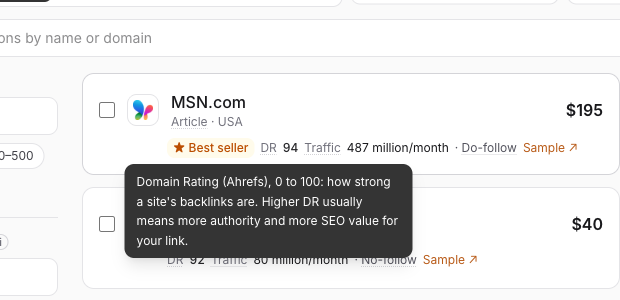
Underlined terms on the Sites page explain themselves when you hover or tap.
Best seller
A badge on the sites that clients order most often. It signals popularity, not quality guarantees.
Guest posting glossary: terms for content
Article (guest post, article posting)
A regular article about your business or topic, published on the site like its other articles. Guest posting and article posting are the same thing. Articles suit brand stories, explainers and opinion pieces.
Press release
An official company announcement, such as a product launch, funding round or partnership, published as a press release and often labelled as one. It is written in a news style, with a headline, summary, quotes and a media contact.
PR package
A bundle that publishes one press release on a whole network of sites for one price. Package families include finance news networks, US local and TV news networks, Indian news networks and an AI Search Listing. See the PR packages page.
Sponsored or partner label
A note some publications add to paid content, as their policy or the law requires. Coneberry never asks them to hide it, and labels are part of how trustworthy publications stay transparent.
Terms for being found
Indexing
When a search engine adds a page to its results. It depends on the search engine and the page, and nobody can guarantee it, including Coneberry.
AI answers and AI search
Google AI, ChatGPT and Copilot write answers from what has been published across the web. Mentions on real publications give them more to draw on when someone asks about your brand.
Reputation and authority
The level of trust people and search engines place in your brand. Being covered by independent publications is one of the clearest ways to build it.
Terms for the dashboard and your order
Sample and sample report
A sample is a real article already published on a site. A sample report is a real distribution report from an earlier press release in a PR package, with live links. Each sample link is checked weekly. See the help article on samples.
Order number
Your Client ID, your initials and a running number. For example, CB-1001JD-3 is the third order of a client whose ID is 1001 and whose initials are JD.
Project Flow
The checklist on your order page. It runs from Order created, Content received, Review and approval and Payment to Publishing, with a line per site that moves from Pending to Live.
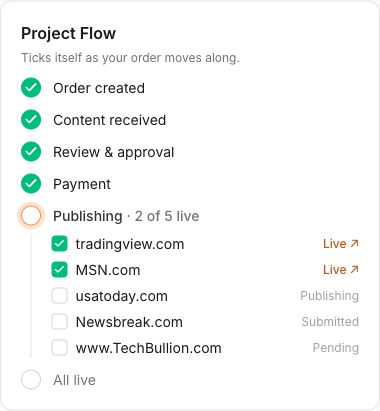
The Project Flow checklist shows each step from order to live links.
Messages
The chat on every order, where you and the team share text, links and files up to 10 MB. Replies appear without refreshing the page.
How the terms fit together
Suppose you want to announce a product. You choose press release in Sites, filter for a minimum DR, check monthly traffic and link type, open a sample, and order. The team reviews your content, you approve it, pay, and follow the Project Flow until every site is live. Each term maps to one step of choosing, checking or tracking, so once you know them, the whole dashboard becomes easier to read and the decisions become faster to make.
What the numbers do not mean
DR, traffic, link type, country and turnaround come from third-party tools and publishers and can change. They are guides, not guarantees. Publications keep the final editorial decision, and Coneberry never promises Google indexing or ranking improvements.
Frequently asked questions
Is a higher DR always better?
No. It usually means a stronger site and a higher price, but audience and topic fit matter just as much.
Which is better, do-follow or no-follow?
Neither is always better. Do-follow can pass authority, while no-follow still brings visibility and readers.
Where do I find these terms in the dashboard?
On the Sites page, hover over or tap any underlined word. It explains itself.
Is guest posting different from article posting?
No. On Coneberry they are the same product, called Articles.
Put the terms to use
The best way to learn the vocabulary is to see it in action. Browse the publications for free, no account needed, and hover over the underlined words. The help center glossary has a shorter version.
More step-by-step help is in the Coneberry Help Center.


