

How Publications Build Your Brand’s Reputation and Authority
Ask a customer why they trust one company over another and the answer is rarely a slogan. It is usually something they saw or read elsewhere: a news story, an article, a mention on a site they respect. That is the idea behind brand reputation built through publications.
This guide explains how being published on real news and business websites builds your reputation and authority, why it matters for search and AI tools, and how to do it sensibly. We also show how Coneberry, a dashboard for publishing articles and press releases on 5,000+ publications, fits in.
Why do outside voices matter more than your own?
Every company says it is reliable, innovative and customer-focused. Readers know that. A statement on your own website is advertising. A statement on an independent publication, even one you contributed to, sits in a different context. It appears next to other news and is judged as part of that site’s content.
Also worth a look: What Are Press Release Packages? A Beginner’s Guide to PR Distribution and Press Release vs Guest Post: Which One Does Your Brand Need?.
That context transfers credibility. A brand that appears on respected sites looks established. A brand that appears nowhere but its own pages looks new, or worse, absent.
What are reputation and authority?
Reputation is the overall impression people have of your brand: whether you are real, reliable and worth their time. Authority is narrower. It is whether people see you as a credible source on a subject, such as finance, health technology or marketing.
Publications help with both. News coverage supports reputation. Informative articles that show expertise support authority.

Browse publications by category, country, price, DR and traffic before you decide.
How do publications build your brand?
1. You are seen where people already read
Instead of asking people to find you, you appear where they already are. A reader of a business news site who sees your brand there is more likely to remember it, and more likely to trust it, than if they found you through an advert.
2. You are easier to find
Before they buy, many people search for a company’s name. If the results show only your website and social profiles, the story is thin. Articles and press releases on independent sites add more results for your name, and they tell your story in a neutral setting.
3. AI tools have more to draw on
People increasingly ask Google AI, ChatGPT and Copilot instead of typing keywords. These tools build answers from pages on the web. When real publications mention your brand and describe what you do, those tools have more material about you. Nobody can promise that an AI answer will mention you, but a bigger, more credible footprint helps. For a closer look, see Showing up in AI search: Google AI, ChatGPT and Copilot.
4. Links can help your rankings, as a bonus
Articles can include links to your website. When search engines treat those links as a positive signal, your rankings can improve over time. We call this a welcome bonus rather than the main promise: nobody controls how Google treats a link. Read Do-follow and no-follow links explained for the details.
Which kind of content builds what?
Different formats do different jobs.
- Articles (guest posts, or article posting) show expertise and tell your story. They build authority. See What is guest posting (article posting)?
- Press releases announce news. They build reputation and create a public record. See What is a press release?
- PR packages spread one release across a network for wide visibility. See What are press release packages?
What makes some publications more valuable than others?
Not all sites carry the same weight. Look at these when you compare:
- Relevance. Does the audience match your customers?
- Domain Rating (DR). A third-party score for site strength. Read What is Domain Rating (DR) and why it matters.
- Traffic. An estimate of visits. See Website traffic numbers: what they mean.
- Samples. A real published article shows you the site’s quality and style.
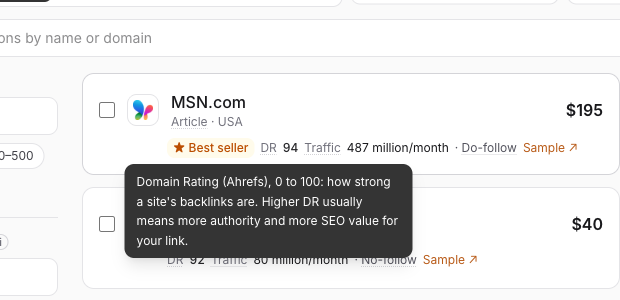
Hover over a term such as DR or Traffic on any card for a plain explanation.
How do you build reputation step by step?
- Decide what you want to be known for. One clear topic is better than many vague ones.
- Pick a few relevant publications. Start with sites that match your customers.
- Publish useful content. Teach something or announce real news. Avoid adverts disguised as articles.
- Repeat over time. Several mentions across months look more established than one.
- Share and reuse. Link the published pieces from your website and profiles, and mention them in sales conversations.
On Coneberry, the dashboard home page keeps a wall of logos of every publication you have appeared on, and you can copy your links or download the list as a CSV.
What can publishing not do?
Keep your expectations realistic. Publications may label content as sponsored or partner content, and Coneberry never asks them to hide that. Google indexing and ranking improvements are never guaranteed. Metrics from third-party tools can change. Publishing supports your reputation. It does not replace a good product or good service.
A practical example
Suppose you run an accounting software company. A prospect hears your name from a colleague and searches for it. If the first results are your own website and a social profile, they have to take your word for everything. If they also find an article by your team on a business news site, and a press release about your latest feature on a finance site, the picture changes. Independent publications have carried your name. You look established, and the prospect feels safer getting in touch.
That is the whole mechanism. Each published piece adds a small amount of credibility, and together they make your brand easier to trust.
Frequently asked questions
How many publications do I need?
There is no fixed number. Start with a few relevant ones and build over time.
Is a bigger site always better?
No. A smaller site your customers read can matter more than a large site they never visit.
How soon will I see an effect?
Reputation builds gradually. The article goes live when published, but search and AI effects take time and are not guaranteed.
Do I need an account to explore?
No. You can browse every publication for free.
Start with the publications
See where your brand could appear. Browse sites on Coneberry, free and with no account needed.
More step-by-step help is in the Coneberry Help Center.


