

Do-Follow vs No-Follow Links: What They Mean for Your Brand

If you have looked at publications for guest posts or press releases, you have seen two labels again and again: do-follow and no-follow. They sound technical, and many guides make them sound more important than they are. This one explains what they mean in plain English and how much they should influence your decisions.
We also show where to find the link type on Coneberry, a dashboard where you can publish articles and press releases on 5,000+ real news and business sites. Every publication card there shows its link type before you order.
What is a link, and why do search engines care?
A link is a clickable connection from one web page to another. Search engines such as Google use links to discover pages and, among many other signals, to judge which pages are trusted. When a respected site links to yours, it works a little like a recommendation.
Also worth a look: How Publications Build Your Brand’s Reputation and Authority and What Are Press Release Packages? A Beginner’s Guide to PR Distribution.
Publishing on news and business sites often includes a link back to your own site. Whether that link passes any trust to your site depends on its type.
What is a do-follow link?
A do-follow link is an ordinary link. Nothing in its code tells search engines to ignore it, so they can follow it and may count it as a signal for the page it points to. In practice, most links on the web are do-follow by default.
What is a no-follow link?
A no-follow link has a small instruction in its code (the “nofollow” attribute) that asks search engines not to treat the link as a recommendation. Publications also use related labels for sponsored or user-generated links. Search engines treat these as hints, and each can decide how to use them.
For the reader, nothing changes. Both types look the same on the page, and a visitor can click either one to reach your site.
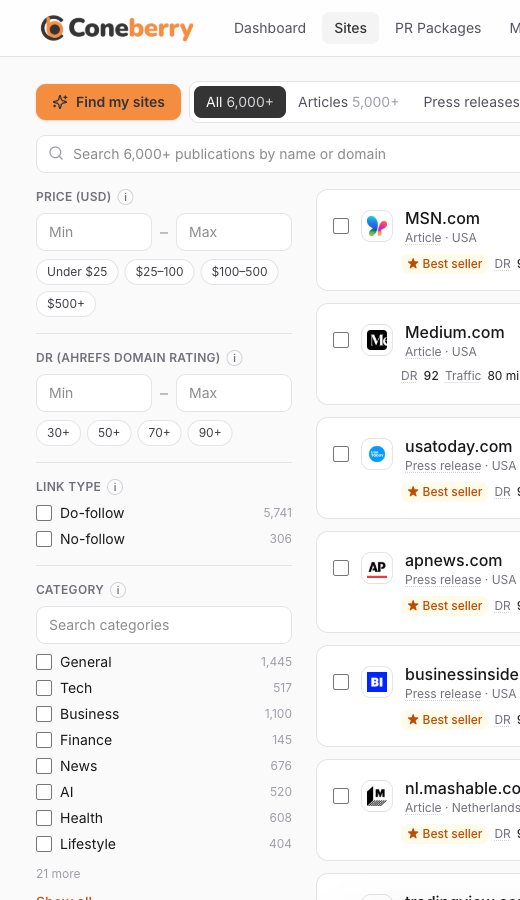
Use the Link type filter to show only do-follow or only no-follow publications.
Why do publications use no-follow?
Many reputable sites mark sponsored or contributed content as no-follow. It is part of how they stay transparent with readers and with search engines. Some publications use it everywhere, some use do-follow only for certain sections, and some require it for press releases. Neither choice means the site is poor quality. A large news site may be an excellent place to publish even though its links are no-follow.
Which one is better?
It depends on your goal.
If you want search ranking support
A do-follow link from a relevant, trusted site is the more helpful signal. But it is only one signal among many, and no one can guarantee ranking improvements or even that Google will index a page. Treat it as a bonus.
If you want reputation and visibility
Link type matters much less. The main benefit of publishing is that readers see your brand on a trusted site, people searching for your name find independent coverage, and AI tools such as Google AI, ChatGPT and Copilot have more pages to learn from. A no-follow article delivers all of that. Read How publications build your brand reputation and authority for the full picture.
If you want a natural profile
A real set of mentions includes both types. A profile with only do-follow links can look artificial. Mixing them is healthy.
How do you check the link type on Coneberry?
- Open Sites. Every card and table row shows Do-follow or No-follow.
- Use the Link type filter in the left panel to narrow the list.
- Hover over the dotted-underlined term to read a short explanation.
- For PR packages, open Details on PR packages to see the link type for the network.
- Select the Sample link on a card to see a real published article from that site.
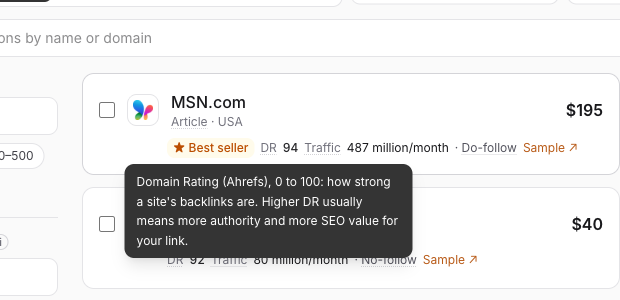
Dotted-underlined terms such as Do-follow show an explanation when you hover or tap.
Other factors worth weighing
Link type is only one column in the list. Compare it with:
- Relevance. Does the site’s audience match your customers?
- Domain Rating (DR). See What is Domain Rating (DR) and why it matters.
- Traffic. See Website traffic numbers: what they mean.
- Country. Choose the markets you want to reach.
What should you not expect?
The link type is set by each publication and can change over time. It is not guaranteed by Coneberry. Publications may label content as sponsored or partner content, and Coneberry never asks them to hide that. Google indexing and ranking improvements are never guaranteed. Be cautious about any service that promises a specific ranking.
Common myths about link types
Myth: no-follow links are worthless
They are not. They send readers, they place your brand on a trusted publication and they support your visibility in search and AI tools. Their only difference is how search engines are asked to treat the link.
Myth: do-follow links guarantee rankings
They do not. Search engines weigh many signals, and rankings are never guaranteed.
Myth: you can safely stuff links into an article
Do not. Publications limit the number of links, and a few natural, relevant links work better than many forced ones. Each PR package lists its link limits under Details.
A simple rule of thumb
Choose first by relevance and audience, then use link type to break ties. If two sites are equally relevant and similarly priced, the do-follow one gives you a little more potential search benefit. If the no-follow site has the better audience, choose that one. Your brand benefits most from being seen by the right readers on a site they trust, whatever the link attribute says. When in doubt, read the Sample article on each card and ask which one you would be proud to show a customer.
Frequently asked questions
Does a no-follow link send any visitors?
Yes. A reader can click it just like any other link.
Can I request do-follow on a no-follow site?
No. The publication decides. Use the Link type filter to find sites that offer what you want.
Is do-follow always worth paying more for?
Not always. If your goal is reputation and visibility, a relevant no-follow site can be the better choice.
Will do-follow links guarantee better rankings?
No. Rankings depend on many factors and are never guaranteed.
See the link types for yourself
Open the list, apply the Link type filter and read a sample article. Browse sites on Coneberry for free, no account needed.
More step-by-step help is in the Coneberry Help Center.


