

Will My Article Be Indexed on Google? What to Expect
You paid for an article on a news site, the link is live, and you search Google for it. Nothing. It is a common worry, and it leads to a fair question about Google indexing: will my article actually be indexed?
The honest answer is that it might be, it often is, and nobody can promise it. This guide explains what indexing is, why it is outside anyone’s control except Google’s, and what you can do to improve your chances. It also covers why indexing is only one of several reasons to publish. We write from the point of view of Coneberry, where brands order articles and press releases on 5,000+ real publications through one dashboard.
What is Google indexing?
Google works in three steps. First it discovers a page, usually by following a link or reading a sitemap. Then it crawls the page, meaning it downloads and reads it. Finally it decides whether to add the page to its index, the huge catalogue it searches when someone types a query.
Also worth a look: How to Show Up in AI Search: Google AI, ChatGPT and Copilot and Website Traffic Numbers Explained: What They Mean When You Choose Publications.
Only indexed pages can show up in Google search results. Being published on a website and being indexed are two different things. The first is decided by the publication. The second is decided by Google.
Why a published page may not be indexed
Google does not index everything it finds, and it rarely explains its choices. Common reasons include:
- The page is very new. Discovery and indexing can take from a few hours to several weeks.
- The content looks duplicated. If the same text appears on several sites, Google often keeps one copy and ignores the rest.
- The page offers little new value. Thin or generic content is easier to skip.
- The site is cautious about paid content. Some publications mark sponsored articles or restrict how they are crawled.
- Technical settings. A publication can tell search engines not to index certain sections.
You cannot see or change most of these. That is why a fair provider cannot guarantee indexing, and why you should be wary of anyone who does.
What Coneberry promises and what it does not
Coneberry promises what it controls: your content is published on the sites you ordered, you approve it first, and you receive live links. If a publisher removes an article within 90 days for a reason that is not caused by the content, we republish it free on the same site or an equivalent one. If a publication declines your content, you get a replacement of equal or greater value, or a full refund for that site. Read the full terms in our refund guide.
We do not promise Google indexing, specific rankings or traffic. Site metrics such as DR and traffic come from third-party tools and can change, so treat them as guides, not guarantees. If you want to know more about those numbers, see What is Domain Rating.

Every site card shows its authority, traffic and link type before you order.
How to check whether your article is indexed
You can check without any special tools:
- Open your order in the dashboard and copy the live link.
- Search Google for the exact article title in quotation marks. If the page appears, it is indexed.
- If not, search for site: followed directly by the full address of the article. If it shows, the page is indexed even if the title search missed it.
- Wait one to two weeks and try again before drawing conclusions.
Google Search Console can also report indexing, but only for sites you own, and you do not own the publication. For pages on other sites, the search checks above are the practical option.
How to improve the odds
You cannot force Google’s hand, but you can make indexing more likely.
Pick sites with real readers
Established publications with steady traffic are crawled more often. The Sites page lets you filter by DR, traffic, country and category, so you can focus on active sites. Our guide to finding the right sites explains how.
Write something original
Publish content that adds something new. If you reuse the same article on several sites, expect Google to keep one version at most. For tips, read how to write a guest post that publications accept.
Give the link some attention
Share the live link on your own website, in social posts, in a newsletter or in a press page. Links from other places help crawlers find the article and show people are reading it.
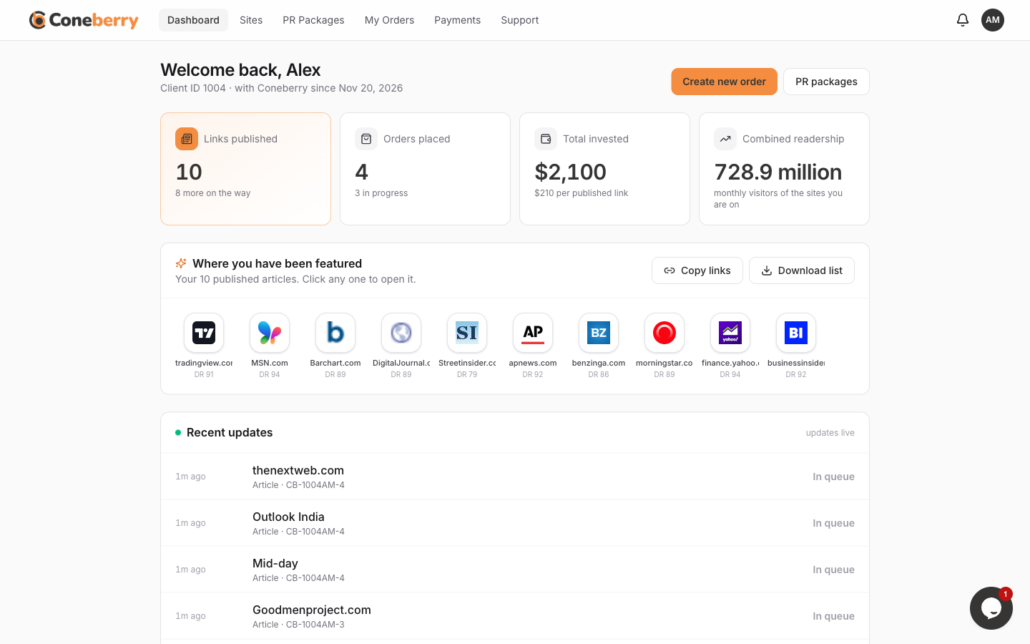
The dashboard lists every live link so you can copy and share them.
Why indexing is not the only reason to publish
Many brands treat indexing as the only measure of success. It is one measure among several. A published article still does real work:
- Readers who visit the publication see your brand on a respected site.
- You can link to the article from your own materials as independent proof.
- AI tools that read the web can find and cite the page. See Showing up in AI search.
- Journalists, partners and customers who search your name find outside coverage, not just your own site.
Better rankings from links can follow, and they are welcome, but they are a bonus rather than a promise.
A realistic timeline
Every site behaves differently, but a typical pattern looks like this. Your article goes live and the publication’s own pages link to it. Search engines may find it within a few days, sometimes sooner on busy news sites. Some pages are indexed within a week; others take a month or more; some are never indexed. If your article is still missing after a month, tell us in your order’s Messages and we will look at it together.
Frequently asked questions
How long does Google take to index a new article?
It varies from hours to several weeks. If the page is still missing after a month, mention it in your order’s Messages so the team can look at it with you.
Does a do-follow link guarantee indexing?
No. Link type affects how authority passes along a link, not whether a page is indexed. See do-follow and no-follow links.
Can I pay to speed up indexing?
Be cautious. Nobody can pay Google to index a page on another site. Offers that claim otherwise are not reliable.
Will a press release be indexed more often than an article?
Not necessarily. Press releases are often published on many sites at once, which means Google may keep only some copies. That is normal and does not mean the release failed.
Next step
Browse the publications by authority, traffic and country, free and without an account, on the Coneberry Sites page.
More step-by-step help is in the Coneberry Help Center.


