

How to Show Up in AI Search: Google AI, ChatGPT and Copilot
A few years ago, people who wanted to learn about a company typed its name into a search engine and clicked a link. Today many of them ask an AI tool instead. They type a question into Google AI, ChatGPT or Copilot and read the answer that comes back. This is AI search, and if your brand is not in the answer, a growing number of potential customers will never hear of you.
That raises a practical question: how does an AI tool decide which brands to mention? This guide explains what we know, what we do not, and how publishing on real news and business sites can help you be found when it counts. We will also show how Coneberry, a place where brands get articles and press releases published on 5,000+ publications, fits into this.
Why AI answers matter for brands
An AI answer is different from a list of search results. Instead of ten links, the reader gets one short summary. The tool names a few companies, describes them and sometimes cites its sources. Being one of those few names is valuable, because the reader often stops there.
Also worth a look: Website Traffic Numbers Explained: What They Mean When You Choose Publications and What Is Domain Rating (DR)? How to Use It When Choosing Publications.
This is why showing up in AI search has become part of brand building, alongside being found in Google and being seen on trusted websites. The goal is the same as it has always been in public relations: when someone asks about your field or your name, the information they find is accurate and favourable.
How AI search finds information about a brand
The details differ between tools and change often, so treat any rule you read with caution. In general, AI answer tools rely on two kinds of information: what they learned from large amounts of text during training, and what they look up on the web at the moment you ask. Both depend on what has been published about you.
Several things make a brand easier for these tools to describe:
- Presence on established websites. A news site or business publication is a stronger source than a page nobody links to.
- Several sources saying the same thing. When three independent publications describe your company in consistent terms, the tool has more confidence in the facts.
- Clear writing. A sentence like “Acme Ltd is a Manchester-based company that makes commercial kitchen equipment” is easy to quote. A vague slogan is not.
- Recent coverage. Tools that search the live web favour fresh, relevant pages.
Notice what is missing from this list: tricks. Nobody has found a reliable shortcut, and anyone who sells you a guaranteed mention is promising something outside their control.
Why publications help
Your own website tells the AI what you say about yourself. A publication tells it what a third party has chosen to publish about you. That second signal usually carries more weight, because publications have editorial standards and a track record.
This is the main reason brands publish articles and press releases on outside sites. The visible benefits are real: readers see you on a trusted name, and people searching for you find independent coverage. The same coverage also becomes material that AI tools can read. Better search rankings from links may follow too, but think of those as a bonus rather than the point.

Each publication card shows its country, authority and traffic so you can pick where to appear.
Choosing content that AI tools can use
What you publish matters as much as where. Content that tends to work well has these traits:
- It answers a real question. “What is a managed IT service and who needs one?” is more useful than a piece that only praises your company.
- It states facts plainly. Name your company, say what it does, where it is based and who it serves, early in the text.
- It is specific. Dates, places, product names and real details are quotable. Generic claims are not.
- It stays consistent. Use the same company name, description and key facts across every piece, so each publication confirms the others.
If you are not sure how to write this, you can read our guides to writing a press release and writing a guest post, or ask Coneberry to write it for you when you place an order.
The AI Search Listing package
Coneberry offers a PR package called AI Search Listing. It publishes your news in places that AI answers read from, so it appears where Google AI, ChatGPT and Copilot look. It is one of several packages on the PR packages page, alongside Yahoo Finance networks, US local and TV news networks, Indian news networks and others.

Press Details on any package to see its outlets, guidelines and a sample report.
Open Details on the card to see what is included and what is guaranteed, and use View sample report to look at a real report from an earlier release. Prices are shown on each card, and placing an order costs nothing upfront. You pay only after your content has been reviewed.
What nobody can promise
Honesty matters here, because this area attracts exaggerated claims. Coneberry gets your content published and sends you live links. We cannot promise that any AI tool will mention your brand, how it will describe you, or how often. These tools decide for themselves and change their behaviour without notice. The sensible approach is to build a solid footprint of accurate coverage and measure what happens.
The same caution applies to search engines. Publication on a site does not guarantee that Google will index the page or rank it highly. Our guide to Google indexing explains this in more detail.
A simple plan to follow
- Write down three facts you want people and AI tools to know about your brand.
- Choose two or three publications that suit your audience and country. Use Find my sites if you want suggestions.
- Publish an article or press release that states those facts clearly.
- Repeat with fresh news every few weeks, keeping your description consistent.
- Every month or so, ask Google AI, ChatGPT and Copilot a customer-style question about your field and note whether you appear.
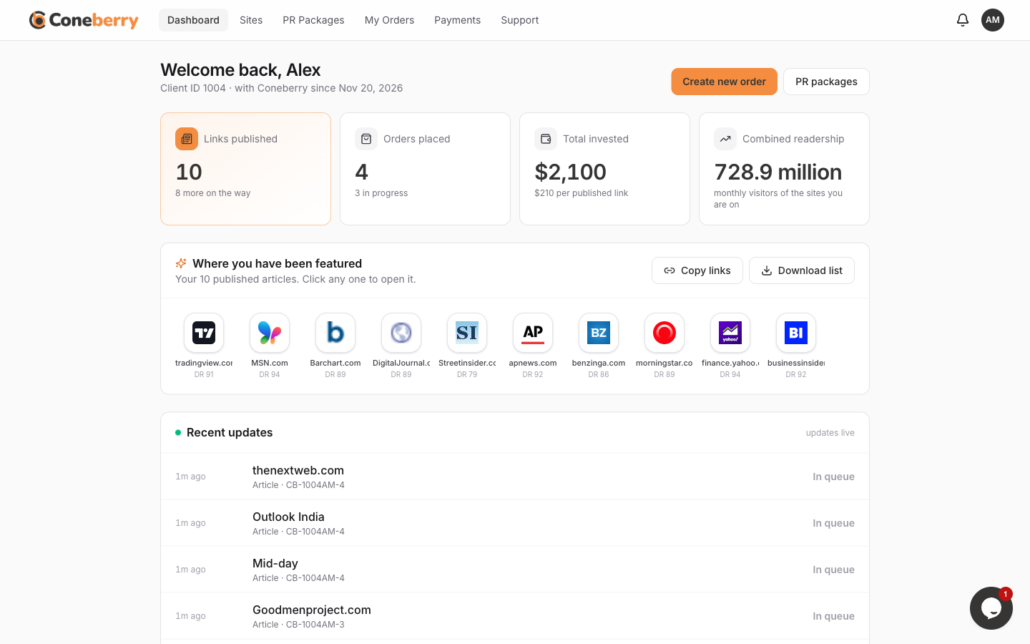
Your dashboard shows every publication you appear on, with links you can copy.
Frequently asked questions
Will an article guarantee that ChatGPT mentions my brand?
No. Published coverage gives AI tools something to find, but each tool decides what to show. Anyone promising a guaranteed mention cannot deliver it.
Is a press release or a guest post better for AI search?
Either can help. A press release announces news; an article explains a topic. Our guide to press release or guest post helps you choose.
How long until I see a result?
There is no fixed time. Some tools read the live web and may pick up new pages within days or weeks, while others update more slowly. Check again after a few weeks.
Do no-follow links count for AI visibility?
Nobody outside the AI companies can say for certain. A published mention can still help readers and tools find you, whether the link is do-follow or no-follow. See our explanation of link types.
Start with the publications
You can browse every publication, with its country, authority and traffic, without creating an account. Browse the sites on Coneberry and see where your brand could appear.
More step-by-step help is in the Coneberry Help Center.


