

Sponsored Labels and Disclosure: What Brands Should Know
You open a news site and see an article with a small tag above the headline: “Sponsored”, “Partner content” or “Brand voice”. Should you worry about sponsored labels if that tag ends up on your own article? Or if it does not?
Sponsored labels on paid or supplied content are a normal part of online publishing. They exist so readers know who is behind what they are reading. This guide explains sponsored labels, why publications use them, what the rules say in general terms, and how brands should think about them when planning guest posts and press releases. It is written from the perspective of Coneberry, a place to get articles and press releases published on 5,000+ news and business websites.
What are sponsored labels?
A sponsored label is a short note that tells readers an article was provided or paid for by a company. You might see “Sponsored content”, “Advertorial”, “Partner post”, “Paid post”, “Press release” or “Promoted”. Where it sits depends on the publication: above the headline, below the author name, in a box at the end or in a disclaimer at the bottom of the page.
Also worth a look: Will My Article Be Indexed on Google? What to Expect and How to Show Up in AI Search: Google AI, ChatGPT and Copilot.
Not every paid article carries a label, and not every label means money changed hands. Some publications label everything that comes from outside their newsroom, including press releases and contributed articles. Others label nothing and rely on their general terms. Each site decides.
Why publications use labels
There are three main reasons.
- Reader trust. Readers should know whether an article was written by the newsroom or provided by a company. Honest labelling protects a publication’s reputation.
- Advertising rules. In many countries, regulators expect paid promotion to be clearly identified. Publications take this seriously.
- Search engine guidelines. Google asks that paid links and sponsored content be marked appropriately, for example with a “sponsored” attribute on links. Our article on do-follow and no-follow links explains how link types connect to this.
None of this is a sign that a site is low quality. Respected publications with real readers often use labels precisely because they take their reputation seriously.
What Coneberry does and does not do
Coneberry never asks publications to hide that content is sponsored. We do not sell label removal, and we would not take an order on that basis. If a publication labels your article, that label stays.
What we do is help you pick sites whose approach fits your goals. Every site card on the Sites page has a Sample link to a real published article, so you can see exactly how that publication presents this kind of content, labels included. We check every sample link weekly and replace it if it breaks.
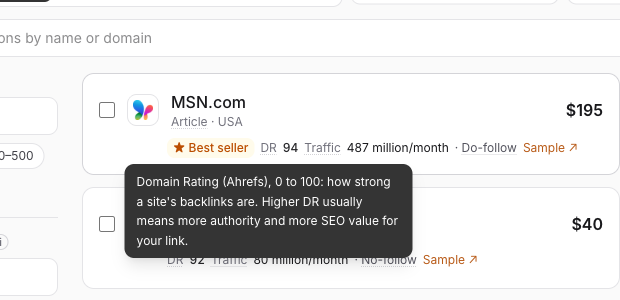
Hover over terms such as Do-follow on a site card to see a plain explanation.
Does a label hurt the value of an article?
Brands often assume a label reduces the benefit. In practice, the value comes from where you are published and what the article says:
- Readers who see your brand on a respected publication still gain familiarity and trust.
- You can show the article to customers, investors or partners as an independent page that carries your name.
- AI tools can read the article. See Showing up in AI search.
- Any link in the article still leads readers to you, whatever its attribute.
The label can influence one thing: how search engines treat the link. A link marked “sponsored” or no-follow may pass less ranking authority than a do-follow link. That is a matter of SEO, and it is why we describe SEO improvement as a welcome bonus and not a promise.
Press releases are labelled differently
A press release is an official announcement. Many networks label it plainly, for instance “Press release” or “Sponsored press release”, because that is how syndicated announcements work. Readers understand the format. If you want to know how a release differs from a guest article, read Press release or guest post: which one do you need?

Package details show what is included and link to a sample report with real live links.
What brands should do
- Decide what matters. If you need an unlabelled article, tell us before ordering, and expect the answer to depend on the site.
- Check samples. Open the Sample link on any site you are considering and see how the publication handles outside content.
- Write honestly. Make factual claims you can support. Avoid misleading statements, and only submit material you have the right to use.
- Follow your own rules. If your industry or country has advertising or disclosure rules, apply them in your own channels as well.
Questions to ask before you order
A few minutes of checking saves surprises later. Before you order on a site, ask yourself whether you are comfortable with the way it presents supplied content, whether the link type (do-follow or no-follow) matches what you need, and whether the topic you want to publish is accepted by the site at all. If you plan to cover finance, health or similar areas, read Restricted topics too. If anything is unclear, write in your order’s Messages, where the team can answer for that specific publication.
Remember also that publications can change their labelling policy over time. A label you see on a sample today may look different in a year, and the policy that applies is the one the site has when your article is published.
Finally, keep perspective. Readers rarely scroll past a label in disgust; what they judge is whether the article is useful, accurate and from a source they recognise. Put your effort into those three things and the label becomes a minor detail.
Frequently asked questions
Can Coneberry remove a sponsored label?
No. Publications control their own labels, and we do not ask them to hide sponsorship.
Will every article on Coneberry be labelled?
No. It depends on the publication. Some label supplied content, some do not. The sample article on each card shows what to expect.
Does a label affect which links are do-follow?
It can. Some sites use no-follow or sponsored link attributes on labelled content. The link type is shown on every site card.
Is a labelled article still worth it?
For reputation, usually yes. A trusted site, accurate content and a live link keep their value, labelled or not.
See how real publications do it
Open the Sample on any card and judge for yourself. Browse publications on Coneberry for free, no account needed.
More step-by-step help is in the Coneberry Help Center.


