

How to Write a Press Release That Gets Published

Every day, journalists and editors receive hundreds of press releases. Most are ignored in seconds. If you want to write a press release that gets read, copy what the published ones share. They share a few simple traits, and none of them is clever wording. They are clear, factual and genuinely newsworthy.
This guide shows you how to write a press release that gets published, step by step, with examples and a checklist. Whether you plan to write it yourself or have someone do it for you, you will know what good looks like. It comes from our work at Coneberry, where brands order press releases and articles on 5,000+ news and business websites through one dashboard.
When to write a press release
A press release is an official announcement from a company, written in the style of a news story. It is meant to be read by journalists, editors and, once published, by the public. If you want the full background, read What is a press release?
Also worth a look: Sponsored Labels and Disclosure: What Brands Should Know and Will My Article Be Indexed on Google? What to Expect.
Write one when you have something to announce: a product launch, a new location, a partnership, an award, a funding round, a major hire, a survey result, an event. If there is no news, a guest post is usually a better format. Our guide to press release or guest post helps you decide.
Step 1: Find the news angle
Ask yourself: why would a stranger care about this today? “We have a new website” is weak. “A Leeds bakery now delivers to 40 towns after opening a second kitchen” gives a reader something concrete. A good angle usually involves one of these: something new, something first, something big, something local or something useful to the reader.
Step 2: Write a headline that says what happened
Keep the headline under about 15 words, in plain language, with the key fact first. Compare:
- Weak: “Exciting news from Acme as we continue our journey”
- Strong: “Acme Ltd opens a second factory in Leeds, creating 60 jobs”
Leave out exclamation marks and capital letters for emphasis. The headline should read like something a newspaper could print.
Step 3: Put the essentials in the first paragraph
Readers and editors often read only the opening. Cover who, what, when, where and why in two or three sentences, and name your company clearly. An example: “Acme Ltd, a commercial kitchen equipment maker, opened a second factory in Leeds on 12 March, adding 60 jobs and doubling its output.”
Step 4: Add detail and two quotes
The next paragraphs should add facts in descending order of importance: numbers, dates, product details, who benefits and how. Then add quotes. A quote should sound like a person, not a slogan. Weak: “We are thrilled to announce this revolutionary step.” Better: “Our Manchester site ran out of space two years ago. This factory lets us ship in days, not weeks,” said Jane Doe, Acme’s operations director.
Give each speaker’s full name and role. Our order questionnaire asks for two quotes for exactly this reason.

The questionnaire for press releases asks for quotes, an About Us paragraph and a media contact.
Step 5: Finish with About Us and a media contact
End with a short “About” paragraph: what your company does, when it was founded, where it is based, and a link to your website. Then give a media contact with name, email and phone number. If you want specific links or keywords in the text, mention them when you send your content, and keep them natural.
The rules that decide whether it is published
Publications and networks screen releases before they run them. Follow these rules:
- Keep it factual. Avoid unproven superlatives such as “best in the world”.
- No misleading claims. Health, finance and legal claims need extra care.
- Use only content you have the rights to. Do not copy text or use images you cannot license.
- Keep to the length limits. The Details of each package list the allowed words, images and links.
- Respect sensitive categories. Crypto, supplements, gambling and similar topics are only accepted by some outlets. See Restricted topics.

Each package lists its outlets, word limits and guidelines before you order.
Common mistakes
- Writing an advert. Calling your product “the best” is not news.
- Burying the news. If the announcement appears in paragraph four, rewrite it.
- Too long. Between 300 and 600 words is usually enough.
- Jargon. If a smart outsider cannot follow it, simplify.
- Missing contact details. Editors who have questions will not chase you.
Writing it yourself or getting it written
If you write your own, put it in a Google Doc, share it as “Anyone with the link: Viewer”, and paste the link into your order. If you would rather not, choose No, please write it for me: you answer a short questionnaire and the team shares a draft in the order chat for your approval. Either way, nothing is published without your approval.
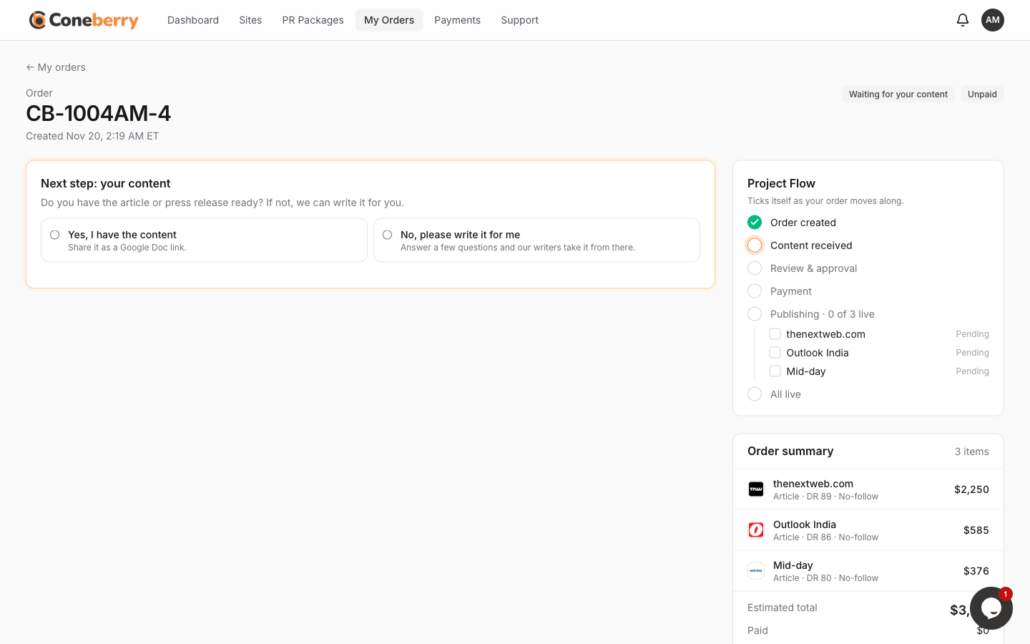
The order asks whether you have the content or want it written for you.
A short example structure
Here is a skeleton you can adapt. The headline states the news. Paragraph one gives the who, what, when and where. Paragraph two explains why it matters and gives a figure or detail. Paragraph three is the first quote, from a founder or executive. Paragraph four adds a second angle, such as what customers can do next. Paragraph five is a second quote, perhaps from a partner or customer. The last two paragraphs are the About section and the media contact.
Read your draft aloud before sending it. If a sentence sounds like a sales slogan, rewrite it as a fact. If a reader could not tell what happened from the first two sentences, rewrite the opening.
Frequently asked questions
How long should a press release be?
Usually 300 to 600 words. Check the package details for specific limits.
Should I include links?
Yes, a few relevant ones, such as your website. Check the package limits and keep the links natural.
Can I use first person?
Use the third person for the main text (“Acme said”), and first person only inside quotes.
Will it definitely be published on every site?
Publications may decline content that does not meet their rules. If one does, you get a replacement of equal or greater value, or a full refund for that site.
Ready to publish?
See where a release can appear, from Yahoo Finance networks to local news sites, on the PR packages page, or browse individual sites on the Sites page. Browsing is free and needs no account.
More step-by-step help is in the Coneberry Help Center.


