

How to Write a Guest Post That Publications Accept

Learning to write a guest post is mostly learning why most are rejected. Editors receive dozens of pitches and drafts, and the majority read like a company brochure with a headline on top. The ones that get accepted do something different: they give the publication’s readers something worth reading.
This guide explains how to write a guest post that publications accept, from picking the topic to formatting the final text. It is written for brands, founders and marketers who have never done it before. We draw on our experience at Coneberry, where brands order articles on 5,000+ news and business websites through one dashboard. Guest posting and article posting are the same thing: a regular article about your business or topic, published on a site like its other articles.
What is a guest post, and what is it for?
A guest post is an article you provide that a publication publishes on its own site. Readers see it next to the site’s other articles. The publication gets content; you get exposure to its audience, an independent page carrying your name and usually a link to your website. For a longer introduction, read What is guest posting?
Also worth a look: How to Write a Press Release That Gets Published and Sponsored Labels and Disclosure: What Brands Should Know.
The aim for most brands is reputation: being seen on trusted sites, being found when people search for you and being visible to AI tools. Search ranking gains from links are a welcome bonus, but writing mainly for links produces weak articles that editors dislike.
How to write a guest post, step by step
Follow these six steps in order.
Step 1: Match the topic to the site
Start with the publication, not your message. Open the Sites page, filter by category and country, and press Sample on a few cards to read real published articles. Notice the length, tone, headline style and the kind of subjects the site covers. Then pick a topic that fits.
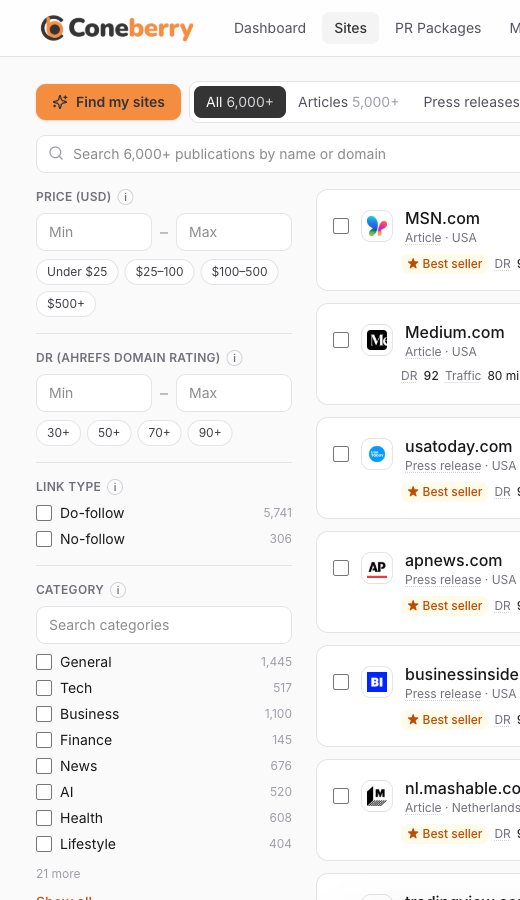
Filter sites by category, country, authority and traffic to find a good match.
If you are unsure, use Find my sites, a six-question guide that suggests matching publications.
Step 2: Choose a useful angle
The best guest posts answer a question. Ask what your customers keep asking you, what mistakes you see them make and what you wish they knew before they bought. Turn one of those into a headline.
- Weak: “Why Acme is the best bakery in Leeds”
- Strong: “How to choose a wedding cake: six questions to ask your baker”
The strong version is useful even if the reader never buys from you, and that is why the publication wants it. Your expertise shows through the quality of the advice.
Step 3: Structure the article
Readers skim, so give them a clear shape:
- A headline that tells them what they will learn.
- An opening paragraph that names the problem and promises an answer.
- Four to six sections with descriptive subheadings.
- Short paragraphs of two to four sentences.
- Examples, numbers, steps or lists where they help.
- A brief conclusion with one takeaway.
Aim for 600 to 1,200 words unless the site’s guidelines say otherwise.
Step 4: Mention your brand without selling
This is where most drafts go wrong. A good rule: the article should still be worth reading if your name were removed. Mention your company once or twice where it genuinely fits, such as an example from your own work, and include a short author line at the end that says who you are and links to your site.
If you need specific links or keywords, tell us when you send the content. Use few, make them relevant and keep them natural. Link type depends on the site, so check whether a card says do-follow or no-follow. See Do-follow and no-follow links explained.
Step 5: Check the rules before you send
- Rights. Submit only text and images you have the right to use.
- Originality. Do not paste text that already exists on your website or another page. Duplicate text is often ignored by search engines.
- Accuracy. Make claims you can support, and avoid misleading statements.
- Regulated topics. Finance, crypto, health, supplements, gambling and adult content are only accepted by some sites. Read Restricted topics.
- Labels. Some publications mark supplied content as sponsored. See Sponsored labels and disclosure.
Step 6: Send it, or let us write it
When you place an order, you are asked whether you have the content. If you do, put your article in a Google Doc, share it as “Anyone with the link: Viewer”, paste the link and press Submit content. You can send one document for all sites or one per site.
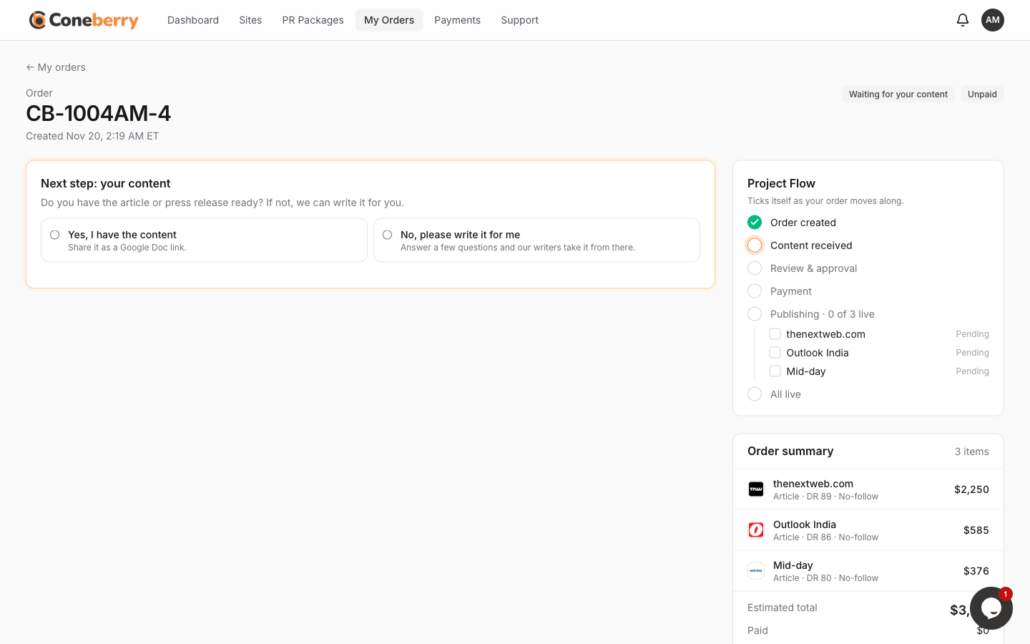
After ordering, you choose whether to send your own content or have it written.
If you do not have it yet, choose No, please write it for me. A short questionnaire asks what the content is about, any special points, your company and website, and any links or keywords you want. The team shares a draft in the order chat. Our guide No content yet? We write it for you has details.
Either way, the team reviews your content, usually within one working day, and nothing is published without your approval.
Common reasons guest posts get declined
- It reads like an advert.
- It does not suit the site’s topic or audience.
- It has been published elsewhere already.
- It makes claims that cannot be supported.
- It has too many links, or links that do not belong.
If a publication declines your content, you receive a replacement of equal or greater value, or a full refund for that site.
A quick checklist before you send
- Does the headline tell readers what they will learn?
- Would the article be useful if your brand name were removed?
- Is every claim something you can support?
- Are the links few, relevant and natural?
- Is the text original and free of anything you lack the rights to?
- Has someone other than the author read it once for mistakes?
Frequently asked questions
Can I reuse a blog post from my own site?
It is better not to. Publications and search engines prefer original text. Write a fresh article, or rewrite your post substantially.
How many links can I include?
It depends on the site. One to three relevant links is typical. Check the site’s details or ask in your order’s Messages.
Do I need a photo or image?
Not always. If you want to include images, use only ones you own or are licensed to use, and mention them when you send your content.
Is a guest post the same as article posting?
Yes. On Coneberry the terms mean the same thing.
Find a publication that fits
Read sample articles and see authority, traffic and category for every site. Browse publications on Coneberry, free and with no account needed.
More step-by-step help is in the Coneberry Help Center.


