

How Much Does a Guest Post or Press Release Cost? Understanding Estimates and Invoices
Anyone shopping for guest post pricing quickly notices how wide the range is. One site charges a modest fee, another many times more, and a press release package costs something different again. If you are new to this, the numbers can look arbitrary. They are not, once you understand what drives them and how the buying process turns an estimate into a final price.
This guide explains how pricing works on Coneberry: where the prices come from, what the estimated total means when you build an order, when the invoice arrives, and how to keep control of your budget. We do not quote specific prices here, because they are shown live on each card and can change.
What is Coneberry?
Coneberry is one place to get articles and press releases published on real news and business websites, so a brand builds its reputation and authority online. You browse more than 5,000 publications in the client dashboard, choose sites or PR packages, send your content (or ask Coneberry to write it), approve it, pay, and receive live links. Browsing needs no account and signing up is free.
Also worth a look: How Paying for Online PR Works: Invoices, Timing and Safe Payment and How Long Does Publishing Take? A Realistic Timeline for Articles and Press Releases.
Why do prices differ so much between publications?
Each publication sets its own rate. Several things push it up or down:
- Authority. A site with a higher DR (Domain Rating) generally charges more. Our guide to Domain Rating explains the score.
- Audience. Sites with larger monthly traffic cost more, because more readers see the article. See traffic numbers.
- Link type. Link type is one of the details shown on each card. The do-follow and no-follow guide covers the difference.
- Format. An article, a press release, and a package distributed across a network are different products with different pricing.
- Topic and country. Sites in certain regions or niches have their own market rates.
A higher price is not automatically better. A smaller, well-matched site can be a stronger choice than an expensive one that your audience does not read.
Where do you see the price?
Every site card on the Sites page shows the price together with DR, monthly traffic, country and link type. Package cards on the PR packages page show the price for the whole network.

Each card shows price, DR, traffic and link type side by side.
How do you stay inside a budget?
The filters on the left of the Sites page do most of the work. Set a price range, then add DR, link type, category, country or traffic. Sorting by price puts the cheapest or most expensive first. If you want help narrowing the list, the guided quiz Find my sites asks about your budget and suggests matches.
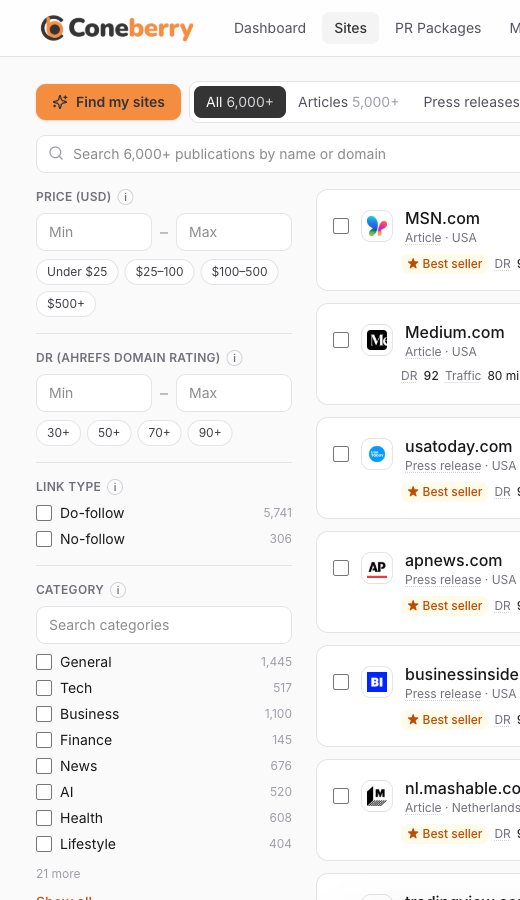
Use the price filter to keep the list within your budget.
What is the estimated total?
As you tick publications, a bar at the bottom shows the estimated total and a Create order button. It is a running estimate of your selection, so you can try different combinations and watch the total change before you commit. Placing the order costs nothing upfront.
When does the estimate become an invoice?
The sequence matters, because it is what protects your budget:
- You place the order. Nothing is charged.
- You send your content, or ask Coneberry to write it.
- The team reviews it, usually within one working day, and you approve it.
- The invoice is added to the order and the status changes to Awaiting payment.
- You pay in full, and the content is sent to the publications.
The invoice is the amount you actually pay. Find it on your order and on the Payments page.
Why might the invoice differ from the estimate?
The estimate reflects the sites you had selected when you ordered. The invoice reflects what was agreed by the time your content was approved. Common reasons for a difference are sites added or removed, a publication replaced after a decline, or extra work such as asking Coneberry to write the content. If the invoice is not what you expected, write in the order’s Messages before paying. The team explains it or corrects it.
What do you get for the price?
You are paying for a placement on a real publication, plus the work around it: review of your content, communication with the publisher, and live links delivered to your order. The refund rules protect that value. If a publication declines your content, you can choose a replacement of equal or greater value or a full refund for that site, and you can cancel before work starts for a full refund. After publication, no refund applies. See Refunds, replacements and cancellations.
One honest caveat: metrics such as DR, traffic and link type come from third-party tools and publishers and can change, and Google indexing and ranking are never guaranteed. Judge a price by fit and reputation value, not by a promise of rankings.
Getting more value for the same budget
Pricing becomes easier to judge when you compare the value, not only the number. Start by deciding what the placement should do for you: build reputation on respected publications, make your brand easier to find, or support a particular announcement. Then shortlist the sites that serve that goal, and compare them using the card details side by side.
For a single announcement that should reach many outlets, a PR package is often the most efficient route, because one price covers a whole network and the Details panel lists what is included. For a story you want told in depth on a few well-chosen sites, individual articles suit better. You can combine both in one order if your plan needs it.
It also helps to start small. Order one or two sites, see the live links and the results in your dashboard, and then expand. The dashboard home shows links published, orders placed and total invested, so you always know what you have spent and what you received.
Frequently asked questions
Are the prices on the cards final?
They are the placement price. Your invoice is the final amount, and it is confirmed after content approval.
Do I pay when I place the order?
No. You pay in full after your content is reviewed and before publication.
What currency are prices in?
US dollars (USD).
Is there a cheaper way to reach many outlets?
PR packages already bundle many outlets into one price. For a larger plan, write to support@coneberry.com.
Compare before you decide
The quickest way to understand pricing is to look. Browse publications, sort by price, and compare DR, traffic and link type on each card. It is free and needs no account: open the Sites page.
More step-by-step help is in the Coneberry Help Center.


