

Publishing Crypto, Supplements and Gambling Content: What to Know
You have a crypto platform, a supplement brand, a casino or a lending app, and you want press coverage. Then you discover that many news sites simply say no. Restricted topics are among the hardest to get published, and the reasons have less to do with your company than with the rules around the subject.
This guide explains why crypto, supplements, gambling and similar topics are restricted, what publications look for, and how to get published on sites that accept them. It comes from Coneberry, a place where brands order articles and press releases on 5,000+ news and business websites, including packages built for categories many outlets refuse.
Why are some topics restricted?
Publications protect their readers, their advertisers and their own standing with search engines and platforms. Some subjects carry more risk of harm or misleading claims than others:
Also worth a look: How to Write a Guest Post That Publications Accept and How to Write a Press Release That Gets Published.
- Finance and crypto. Readers can lose money. Regulators in many countries restrict how investments are promoted.
- Health and supplements. Claims about curing, preventing or treating conditions are tightly controlled, and false ones can cause real harm.
- Gambling. Legal in some places and banned in others, with strict advertising rules and age limits.
- Adult content. Most mainstream news sites will not touch it.
A site that refuses these topics is not saying your business is bad. It is applying a blanket policy. That is why the first step is finding sites whose policy fits.
Restricted topics in more detail
Crypto and blockchain
Many general news sites avoid promotional crypto content. A smaller set of finance and technology publications accept it, usually with conditions such as a risk disclaimer and no promises of returns. Coneberry offers a package for crypto and supplements, intended for categories that many outlets refuse. Open Details on its card to see which outlets are included and what guidelines apply.
Supplements and nutrition
Expect scrutiny of every health claim. “Supports healthy digestion” is more likely to be accepted than “cures bloating”. Where a claim relates to a medical condition, publications may ask for evidence or decline the piece.
Gambling and betting
Acceptance depends on the country. A site that serves a market where gambling is regulated may allow licensed operators and require licence numbers and responsible-gambling messages. Sites in other markets will decline.
Finance and investing
Announcements such as funding rounds, new products and company results are often fine. Promises of profit, “guaranteed returns” or advice presented as fact are not.
How to find sites that accept your topic
- Open the Sites page and filter by category and country.
- Press Sample on a site’s card and read the article. If similar content has been published, that is a good sign.
- Ask in your order’s Messages, or email support@coneberry.com, if you are unsure.
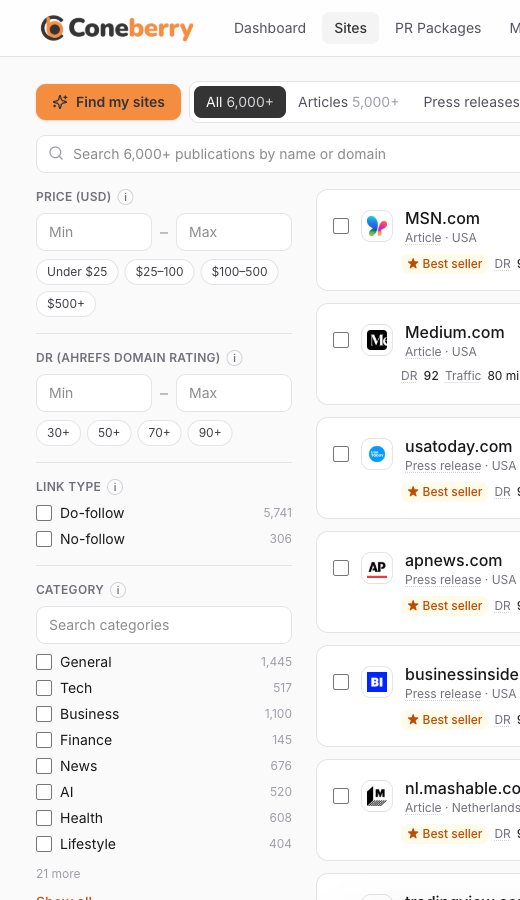
Filter by category and country, then open a Sample to see what a site has published.
The PR packages page also lists networks, and each package’s Details show its guidelines.
Write content that is more likely to be accepted
- Lead with facts. A licence granted, a product launched, a partnership signed: concrete news beats claims.
- Avoid guarantees. Never promise profits, cures or winning outcomes.
- Include required notices. Risk warnings, licence numbers, age limits and “not medical advice” lines show good faith and are often required.
- Support what you say. If you cite a study or statistic, name the source.
- Use only content you have the rights to. That includes text, quotes and images.
For general advice on structure, see How to write a press release that gets published and How to write a guest post that publications accept.

Package details list the outlets, what is guaranteed and the guidelines to follow.
What Coneberry does and does not promise
Coneberry only places regulated topics on sites that accept them, and our team reviews your content before anything goes out. If a publication declines it, you receive a replacement of equal or greater value, or a full refund for that site. After an article is published there is no refund, and if a publisher removes it within 90 days for a reason not caused by the content, it is republished free on the same or an equivalent site.
We cannot promise that any specific publication will accept a restricted topic before it has reviewed the content, and we cannot promise Google indexing or rankings. Some publications label supplied content as sponsored, and we never ask them to hide it. See Sponsored labels and disclosure.
A practical example
Imagine a company that sells a plant-based protein powder and wants an article about its new product. The first draft says the powder “cures fatigue and boosts immunity”. Most publications will decline that. A second draft says the powder contains 25 grams of protein per serving, is made from pea and rice protein, and is sold in three flavours, with the usual note that it is not intended to diagnose or treat any condition. That version is factual, checkable and far more likely to be accepted. The facts are the same product; only the framing changed.
The same thinking applies to a crypto exchange announcing a new listing, or a licensed betting company announcing a partnership. State what happened, who is involved, and what the licence or regulation allows. Leave out predictions and promises.
If you are still unsure after reading this, the cheapest step is a question. Describe your topic in your order’s Messages, or by email, and the team can tell you which sites are realistic before you spend any time on a draft.
Frequently asked questions
Can I publish crypto news on Yahoo Finance sites?
Acceptance depends on the network and the content. Check each package’s details, and for categories that many outlets refuse, look at the dedicated crypto and supplements package.
Do I have to include a disclaimer?
Often yes. Risk warnings, licence details or health disclaimers are commonly required and protect you as well as the publication.
What if I am not sure whether my topic is restricted?
Ask before ordering, in Messages or at support@coneberry.com. It is quicker to check than to have content declined later.
Will the price be higher?
Prices are shown on each site and package card, and the invoice is confirmed after your content is reviewed. Ask us if a card is not clear.
See what is available
Browse publications and read real samples, free and without an account, on the Coneberry Sites page.
More step-by-step help is in the Coneberry Help Center.


